
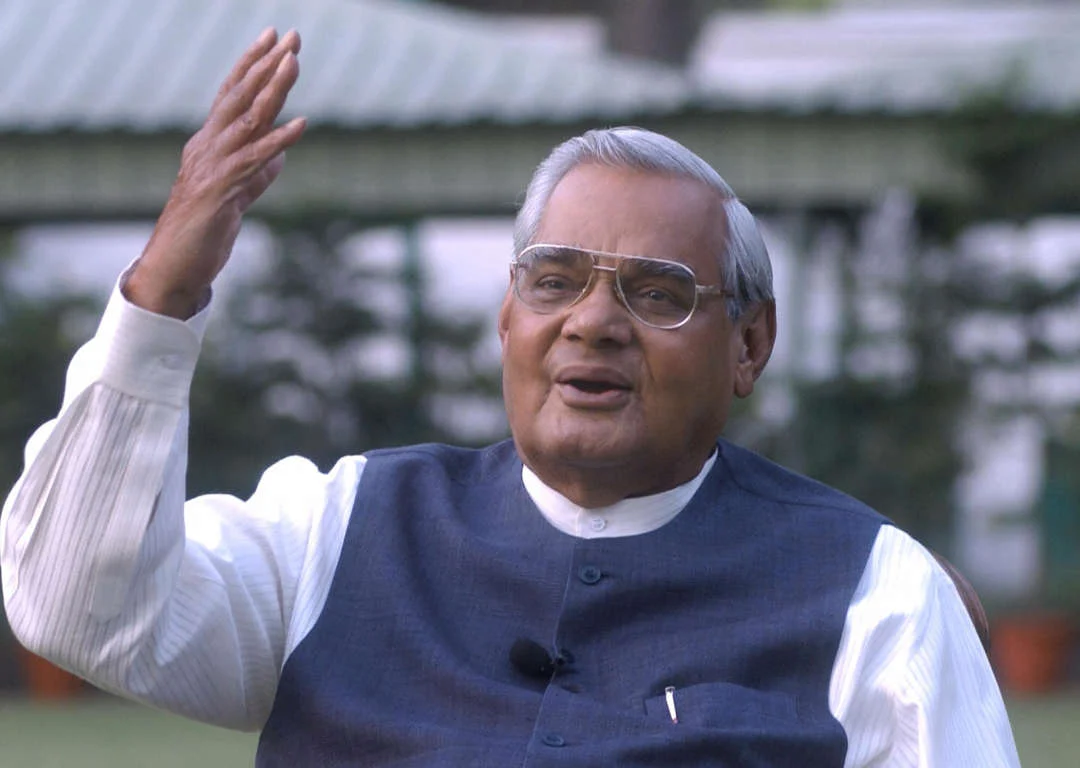
“Amar Ajay Atal.”
Three words to capture more than a name, rather to evoke an era, an ethos, and a rare kind of leadership that blended conviction with compassion. Not merely a prime minister or a politician, Atal Bihari Vajpayee was a voice of conscience in Indian public life. From the galleries of Gwalior to the highest office of the nation, his journey stands as one of the most compelling political stories of modern India.
Vajpayee’s dialogue choices would be a strong point in the political landscape, often marked by confrontation. In times of uncertainty, he offered reassurance, and in moments that demanded strength, he delivered resolve. His career reflects the possibility that politics can be principled, poetic, and purposeful—all at once.
The Early Years of Atal Bihari Vajpayee
A Childhood Shaped by Learning and Culture
Born on 25 December 1924 in Gwalior, he grew up in an environment where education and cultural expression were deeply valued. His father, a teacher and poet, played a formative role in nurturing his love for language and ideas. These early influences later reflected in Vajpayee’s reputation as one of India’s most eloquent parliamentarians and respected public thinkers.
From a young age, Vajpayee displayed a natural command of words. His ability to articulate complex ideas with clarity and grace would eventually become one of his defining strengths. This early grounding in Hindi literature and Indian philosophy helped shape a leader who valued both tradition and progress.
Education and Intellectual Orientation
Vajpayee pursued higher education in political science and humanities, disciplines that broadened his understanding of governance, democracy, and global affairs. Unlike many political leaders who rise solely through activism, Vajpayee entered public life with a strong intellectual foundation. This academic grounding contributed significantly to his later success as a thoughtful policymaker and consensus builder.
Entry into Politics: The Rise of a New National Voice
Ideological Roots and Early Associations
Vajpayee’s political journey began with his association with the Rashtriya Swayamsevak Sangh (RSS) and later the Bharatiya Jana Sangh, the ideological predecessor of the Bharatiya Janata Party (BJP). While firmly rooted in nationalist thought, he distinguished himself through moderation and openness.
Even in his early years, Vajpayee showed an ability to balance ideology with inclusiveness. This quality allowed him to engage constructively with leaders across the political spectrum, earning respect beyond party lines.
Parliamentarian Excellence
Elected to the Lok Sabha in 1957, Vajpayee quickly emerged as a standout figure in Indian parliamentary politics. His speeches were noted for their balance, wit, and depth. Leaders from rival parties often acknowledged his oratory skills and parliamentary ethics.
This phase established him as a leader of substance long before he assumed executive power. His reputation as a parliamentarian laid the groundwork for his later role as a national leader.
Democracy Under Threat: The Emergency Years
Standing for Constitutional Values
The declaration of the Emergency in 1975 marked a defining test for Indian democracy. Vajpayee was arrested and imprisoned during this period, an experience that reinforced his belief in civil liberties and democratic institutions.
Rather than emerging embittered, he returned to public life with renewed commitment to constitutional governance. His conduct during and after the Emergency strengthened his image as a principled leader.
Minister of External Affairs and Global Recognition
As Minister of External Affairs in the post-Emergency government, Vajpayee played a key role in restoring India’s international standing. His historic decision to address the United Nations General Assembly in Hindi symbolised cultural confidence and national self-respect, earning widespread acclaim.
Building a National Alternative: BJP and Coalition Politics
Shaping the Bharatiya Janata Party
With the formation of the BJP, Vajpayee became one of its most recognisable faces. He worked to position the party as a credible national alternative, capable of governance rather than mere opposition.
His emphasis on democratic norms and coalition-friendly politics helped broaden the BJP’s appeal. This approach proved crucial during an era when coalition governments became the norm.
Mastering Consensus Politics
Vajpayee’s greatest political skill was his ability to lead diverse alliances. Under his guidance, the National Democratic Alliance (NDA) emerged as a stable governing coalition. His leadership style demonstrated that coalition governance could be both stable and effective.
Prime Minister of India: Leadership with Vision
A Historic Political Journey
He served three terms as Prime Minister of India, with his final tenure from 1999 to 2004 marking a period of significant transformation. His leadership during this phase reshaped India’s approach to national security, infrastructure development, and foreign policy.

Defining Achievements of the Vajpayee Era
Pokhran-II and Strategic Confidence
One of the most discussed milestones of Vajpayee’s career was the Pokhran-II nuclear tests in 1998. This decisive move established India as a responsible nuclear power and reshaped global perceptions of Indian strategic capability.
Despite facing international sanctions, Vajpayee navigated the situation with diplomatic maturity. His handling of the aftermath highlighted his ability to balance national security with global engagement.
Infrastructure and Economic Momentum
Vajpayee believed that development should be visible and inclusive. Projects like the Golden Quadrilateral highway network transformed national connectivity, while rural road initiatives strengthened economic integration.
These infrastructure programs are often cited as benchmarks in India’s development story and remain key Atal Bihari Vajpayee achievements.
Governance and Administrative Balance
Known for his measured approach, Vajpayee emphasised transparency, institutional respect, and cooperative federalism. His governance model focused on empowering institutions rather than concentrating authority, reinforcing democratic stability.
Foreign Policy: Dialogue Backed by Strength
The Lahore Bus Yatra and Peace Initiatives
Vajpayee’s Lahore Bus Yatra stands as a landmark moment in India-Pakistan relations. By choosing dialogue and people-to-people contact, he demonstrated that diplomacy could coexist with firmness.
Although subsequent events challenged these efforts, his commitment to peace through dialogue remains a defining aspect of his legacy.
Leadership During the Kargil War
The Kargil conflict tested India’s resolve and leadership. Vajpayee responded with clarity and restraint, ensuring military success while maintaining international credibility. His handling of the crisis reinforced India’s image as a responsible democracy.
The Poet and the Politician
Vajpayee’s Poetry and Inner World
Beyond politics, Vajpayee was a celebrated poet. His poetry reflects themes of nationalism, introspection, and human resilience. His literary work offers insight into the emotional depth behind the statesman.
Language as a Bridge
His commitment to Hindi and Indian cultural expression never excluded pluralism. Instead, he viewed language as a unifying force, capable of bringing people together across differences.
Personal Life, Values, and Public Trust
Simplicity in Personal Conduct
Despite holding the highest office, Vajpayee lived a life marked by simplicity and restraint. He never married and maintained a low-profile personal life, focusing entirely on public service.
Integrity and Credibility
Perhaps Vajpayee’s most enduring success was his reputation for honesty and dignity. In an era of political scepticism, he remained widely respected—even by opponents—for his integrity and intentions.
Legacy and Remembrance: Amar Ajay Atal
His legacy extends far beyond electoral victories or policy milestones. He is remembered as a visionary Indian PM, a poet-statesman, and a leader who elevated political discourse.
Honoured with the Bharat Ratna and commemorated through Good Governance Day, his influence continues to guide conversations on leadership, democracy, and national development.
It is not merely a slogan—it is a reflection of a life that demonstrated how power, when guided by values and vision, can leave a lasting imprint on a nation.

2 thoughts on “Was Atal Ji the Best Indian Prime Minister?”
He will always be India’s Best Prime Minister.
He shaped the values, by which BJP is able to make India what it is today. Best leader to a country