Hitler doesn’t live here anymore.
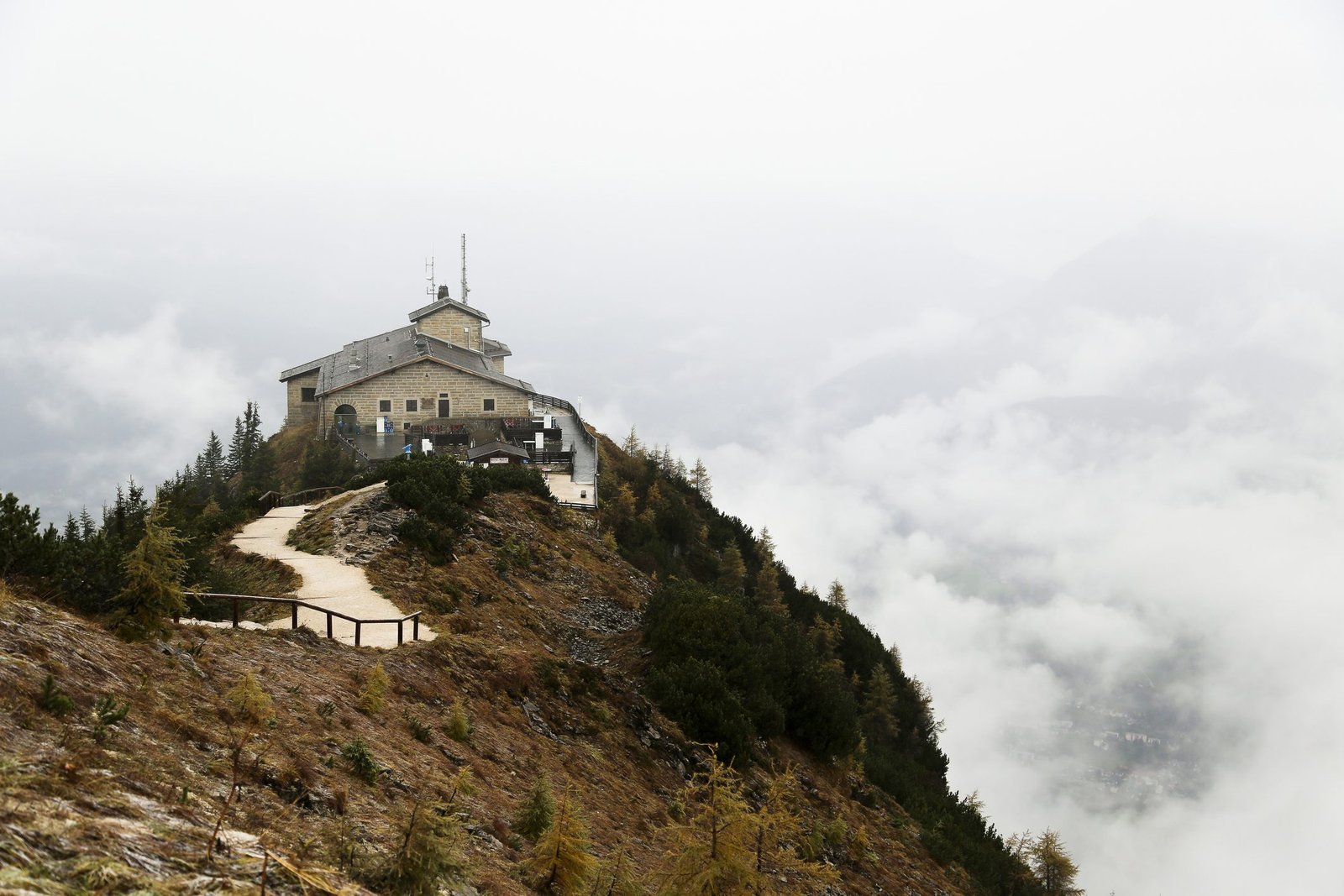
Hitler’s “Eagle’s Nest,” the Bavarian villa where some of the tough decisions regarding the extermination of European Jews were made, is set to become a resort, with a luxury hotel at its center. Sixty years later, Germans are determined to start forgetting. Germany‘s Jewish community is divided on how far we must go to make Germans remember.
“There I spent the most wonderful hours of my life, in this place I conceived all my great projects, and there they matured…”
Adolf Hitler, at his residence in the Bavarian mountains known as the “Eagle’s Nest” (from “The Rise and Fall of the Third Reich”, by William Shearer, Schocken Publishing). In 1939, when the Nazi Party in Germany sought to give Adolf Hitler a significant gift in honor of his 50th birthday, it gave him the “Eagle’s Nest”.
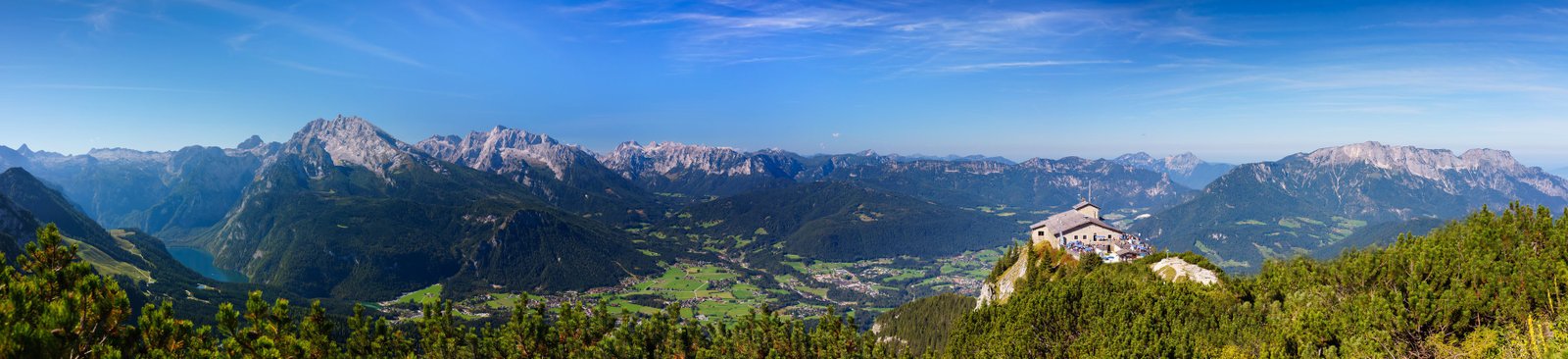
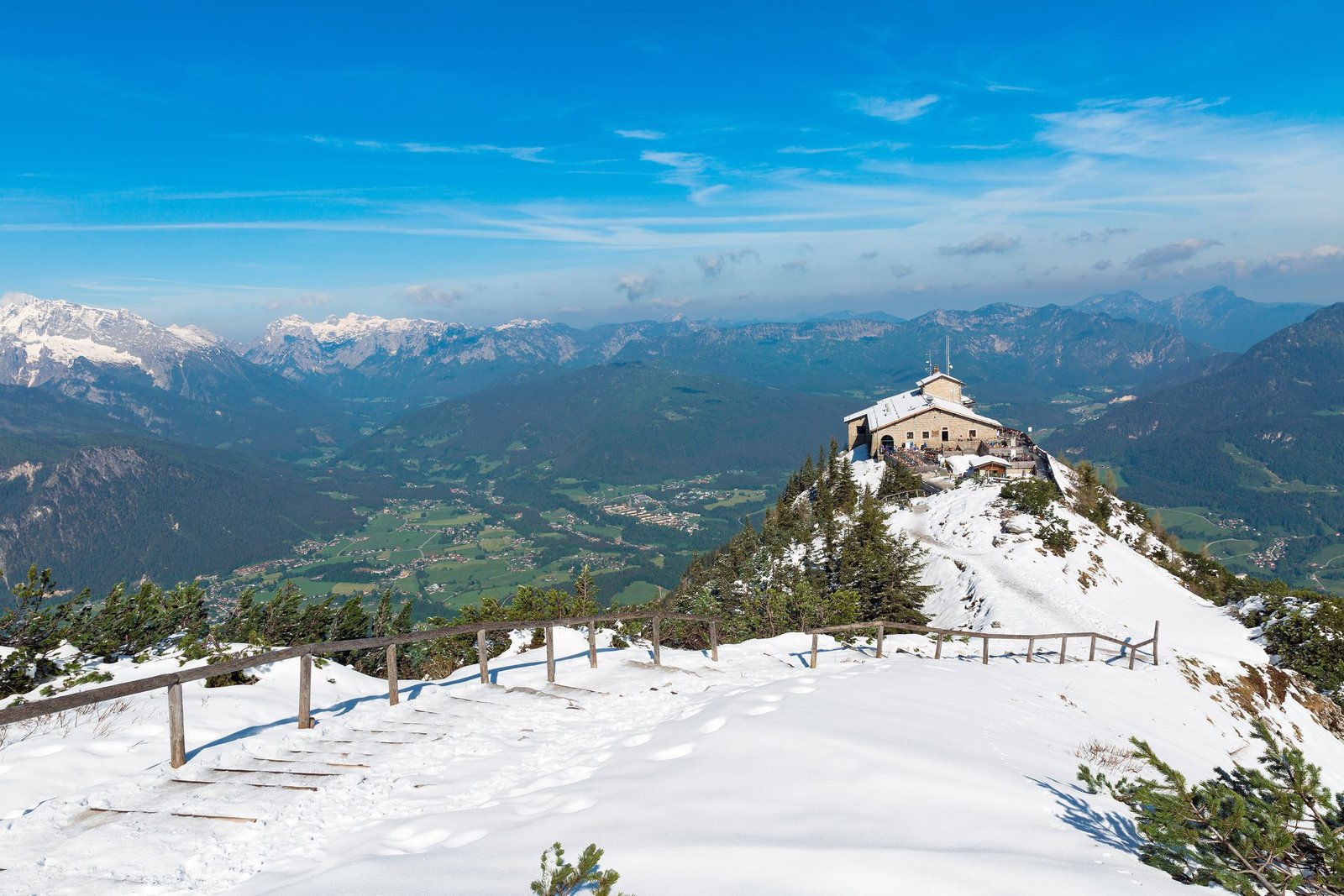
In the southeasternmost corner of Germany, on one of the peaks of the Bavarian mountains (Obersalzberg), at a point that allows a panoramic view of the Alps and overlooks Salzburg in Austria from a distance, the villa that was given to Hitler was built over three years – as far as the magnificent palace can be described in this way- and was connected to a huge underground fortress and fortified tunnels hundreds of meters long.
Right now, 62 years after Hitler took up residence in his villa, and some 56 years after he committed suicide with his lover in a bunker in Berlin, at the end of World War II, large-scale construction work is beginning on the Eagle’s Nest, with an investment of 140 million marks (about $65 million). Eventually, it will become a luxurious, four-story hotel with 138 rooms, a golf course, and open areas for sports activities.
1000′s of Germans and tourists from all over the world are expected to visit the site. Some will come specifically to enjoy the incredible view from the cliff. Others will combine it with a trip to the nearby Alps, in Bavaria or Austria. They will likely know, at least vaguely, that the man responsible for the most horrific atrocities of the human race once lived there. But they will also likely not give the matter much thought.
After all, the investors (US Interconti Group, together with Bavarian State Bank) are putting their hands deep into their pockets not to build a memorial site, but a resort. They will not even let the symbolic fact that the new hotel will stretch from Hitler’s house to Hermann Goering’s house, which was located nearby, get in the way.
“A creation of a mad mind”
It was no coincidence that the party leaders chose to give Hitler a house at this very spot. Hitler’s love for the area was well-known. Since his release from a German prison, he had spent many of his vacations around the town of Berchtesgaden, above which the Eagle’s Nest is located. “So many things were born there,” he used to say of the area where he wrote the bulk of “Mein Kampf.” Initially, his half-sister, Angela Raubl, and her two daughters would accompany him on his vacations there. Later, the place became a favorite recreation area for him and his lover, Eva Braun.
The French ambassador to Berlin until 1938, André François-Ponset, who was invited to visit the nest by Hitler, wrote: “It was very difficult to get to the Eagle’s Nest. To the fantastic, isolated villa, built at enormous expense, a road like the head of a pin led, cutting into the mountainside, and from there to a long underground passage, drilled into the rock. From there, the ascent was by elevator, another 120 meters to the summit, to the Eagle’s Nest.
There, at an altitude of 2,000 meters, the view was breathtaking. But was this palace the creation of a normal human mind, or of a mad, megalomaniac mind, haunted by visions of control and solitude?” the ambassador wondered.
Goering, the commander of the air force, Martin Bormann, Hitler’s personal secretary, Albert Schaefer, the Minister of Procurement, and other Nazi leaders who sought the Führer’s proximity, lived in the same area, in luxurious villas equipped with underground bunkers and adjacent to military camps. In fact, the area served as Hitler’s southern military headquarters during the war.
Hitler’s Eagle’s Nest was a place of immense historical importance before and during World War II. It was there that Hitler forced Austrian Chancellor Kurt von Schuschnigg, in February 1938, to agree to Germany’s control of Austria. It was there that Hitler met with British Prime Minister Neville Chamberlain to discuss Germany’s claims to Czechoslovakia for the first time face to face. It was there that Hitler planned the invasion of Russia. During World War II, Allied bombing destroyed most of the buildings in the area, but the extreme structure of the palace, at the edge of the cliff, remained standing.
Many tourists have been visiting the area for years. Its breathtaking beauty attracts them. For their convenience, a cafe-restaurant has been operating in the building on the cliff for many years. But the place also serves as a pilgrimage site for neo-Nazis from around the world, especially on Hitler’s birthday, which falls on April 20. Then many of them gather in the underground passage leading to the house to celebrate the Führer’s birth.
Until about two years ago, the underground passage was “decorated” with Nazi symbols, and the display in the house itself also emphasized very specific aspects of the Führer’s past. It mainly featured pictures of Hitler in uniform, smiling and hugging German children, who looked at him with adoring eyes. Only a few pictures there depicted the horror.
Following protests from Jewish organizations, the display was changed, and the underground passage was also cleared of symbols. Dr. Avi Becker, CEO of the World Jewish Congress in Israel, says that the new display certainly puts the Holocaust, the war, and the atrocities of the Nazis in the right perspective. Even so, it hasn’t stopped neo-Nazis from all over the world from visiting the place.
Becker is not satisfied with the construction of the huge hotel on the site, but he believes he cannot stop economic entrepreneurship. Therefore, he believes it is important to try to ensure that when the project is built, every effort is made to give adequate expression to the historical chapter of the place.
But not everyone agrees with Becker’s compromising approach. Michael Friedmann, vice president of the Jewish community in Germany, argues that building the hotel is a historical mistake. “We believe that the Bavarian government’s decision to sell this area, especially so that a hotel can be built on it, is wrong,” he says.
“The fact that a huge hotel will be built in the Eagle’s Nest, which is a place of relaxation and joy, a place to live, creates an unpleasant feeling. We feel very uncomfortable, because such a historic place will lose the authenticity it had before. After the hotel is built, no one will remember that meetings of senior Nazi leaders and decision-makers about the extermination of the Jews were held in this place.”
“In ten or twenty years, no one will remember that this was the private home of the greatest Nazi murderers in the Third Reich, where these discussions were held, and terrible decisions were made. Therefore, from our perspective, this is a historical mistake, and a misunderstanding of how to act in relation to such historical places.”
“They’re tired of us”
The decision to build the luxurious hotel passed in Germany with almost no protests. The German authorities were careful to express their unqualified support for the new construction project. “The Bavarian government welcomes the opening of the impressive new hotel,” said Bavarian Finance Minister Kurt Flattelhauser on July 6, at the project’s ribbon-cutting ceremony.
“The hotel is perhaps the most important contribution to changing the perspective of the place. The first guests arrived in the area back in the 18th century, when the ‘Pension Moretz’ opened here. Later, Hitler made the place his residence and conducted his harsh propaganda from here.
“The new place that will be built is intended to bring a new spirit to the place, a new and different kind of propaganda. In a special wing, historical items from that period will be displayed, so that everyone can learn from it for the future, especially the younger generation. Millions have been invested in the place, and our goal is to combine history and tourism together, in order to bring about the renewed flourishing of the site.”
In light of the unequivocal position, German Jews remain divided among themselves as to the appropriate response, if any. The fear of being perceived by Germans as “harassers” and “compulsive Holocaust conservators” seems to be influencing protest activity, even if not explicitly.
The Jews understand that a unified Germany, with its construction boom, prosperity, and growing economic power, wants to start forgetting. The chances of stopping the project are low, and the opponents will not easily position themselves as those seeking to stop the momentum.
“We expressed an official protest on the subject, in newspapers and electronic media, but the German and Bavarian governments did not respond,” says Friedman. “This is another sign that raises the question of whether this country, deep down, really wants to continue the work of memory, and whether there is a real change in the recognition and preservation of memory.”
Were there any other protests or reactions to the decision to build the hotel?
“We were the only ones who responded. No political organization in Germany responded. Everything was done in complete silence; no one understood our arguments. They really got tired of us.”
What were the arguments against you?
“They said, if there was a concentration camp there, we would understand. But it was just a private house. But what do you mean, ‘just a private house’? It was the place where these people were. Therefore, either the place must be preserved in an authentic way, or if you want to change it, you must do so in a way that does not ignore those who live there.”
“I’m sure that twenty years ago it wouldn’t have been possible to build a hotel in a place like this. Back then, politicians would have felt ashamed or seen danger in the reactions that such an act would entail. Today, the reaction is not taken seriously by them; it is not included in their considerations. The fact that today it is possible is a symbol of a change in the perception of responsibility, a change in the recognition, consciousness, and awareness of society and the state.”
Ghosts of the past resurrected?
“No, it has nothing to do with that. The point is that ten years ago a new era of German self-consciousness began. The common saying today is, we know what happened, we accept what happened, it was a catastrophe, but there is also a future. So don’t tell us, every time, every place, every moment, that our future must be directly connected to this past.”
What is the reason for the change?
“I believe that today the third German generation after the Holocaust is becoming the generation of decision-makers. We don’t need to talk about the generation of murderers. Their children, who are the age of Joschka Fischer (Foreign Minister), are in a terribly ambivalent situation, both regarding their private family history and regarding the political lesson. Only their children, now, for the first time, will be the thermometer of the new Germany.”
“In ten years, we will be able to see whether Germany is on the good or bad side of the world. But if we take into account that 25% of young Germans, between the ages of 14 and 21, do not know what Auschwitz is, and 20% do not know who Hitler was, we can wonder about our society in Germany. If they do not know, how can they understand? And if they do not understand, how can they learn?”
German Trap Professor Moshe Zimmerman, head of the history department at the Hebrew University of Jerusalem, believes that the problem is more complex. According to him, the danger is that the attraction of visiting the place will be due to its proximity to the former residences of senior Nazis, but in this regard, the construction of the hotel neither increases nor decreases. Visits to the place as a vacation area are made anyway, and those who want to visit it because they miss Hitler will do so, one way or another – and such visits are made frequently.
According to Zimmermann, who himself has visited the Eagle’s Nest several times, today’s Germany faces a dilemma. As long as the remains of the buildings were not demolished, there were claims that they were a tourist attraction with a nostalgic feel. As soon as the remains are demolished, they claim that the construction is actually a tourist attraction, with a nostalgic feel. Whatever they choose to do, there will always be someone who will complain. That’s the trap Germany finds itself in.
The solution, he claims, is to let the Germans decide. There is no need to intervene, as long as no action is taken there that explicitly encourages sympathy for Nazism. As soon as there are pamphlets that say, “Come lie on the holy ground where Hitler lay,” then there will be room for a response, he says.
In the construction of the hotel itself, according to Zimmermann, there is nothing jarring or unjarring. The only important thing is that nothing be done that encourages or arouses sympathy for Nazism. To clarify his position, Zimmermann says that he once rented an apartment in Munich, on the street where the Nazi “Brown House” stood, which housed the headquarters of the Nazi organizations.
Although Zimmermann was aware of the historical context of the buildings on the street, this still did not make him a Nazi sympathizer. In his opinion, memories exist without necessarily evoking sympathy, and many times memories are erased. It can be assumed that the average person in Germany would be interested in erasing memories.
Zimmerman believes that the claim that Germany is moving towards erasing its memories has two edges. Indeed, there are people in Germany who don’t know who Hitler was, but some of them also don’t know what anti-Semitism is.
It is clear, he says, that Germans are reluctant to spend all day talking about the memory of the Third Reich. But as a scientist, he testifies that in recent years more memorials have been erected and there are more days of remembrance in Germany. German government involvement in remembrance activities has increased, and the organization of German collective memory has become institutionalized and widespread.
A Conversation from the Heart of the Death Industry. In response to questions directed at him, Bernard Holmer, a spokesman for Gewerbegrund, one of the companies involved in the construction project, said that the contracts signed do not allow the hotel owners to accept Nazis or neo-Nazi groups to stay there. He added that the construction company is making every effort to place the historical display that will be displayed on the site in a central location, thus allowing visitors to the site to learn about Nazi crimes.
Prof. Shevach Weiss, a Holocaust survivor, former Speaker of the Knesset and currently Israel’s ambassador to Poland, is not impressed by these things.
In an almost macabre way, my phone rings as he is inside the gas chamber at Majdanek, along with 15 Israeli ambassadors who have come there for a visit, as part of a conference they are attending. “What can you do when life sometimes calls for such macabre things?” he says. “Without any prior planning, you interview me and ask me about the construction at the Eagle’s Nest when I am inside the gas chamber, talking to you right from the heart of Hitler’s death industry.” Do you oppose construction there?
“Building a hotel in the Eagle’s Nest is shocking. This is a Holocaust industry; this is frivolity, insensitivity; this may stem from the era of commercialization of everything, without borders, without a soul. This is part of the attempt to comprehensively museumize all sites and places related to the brutality of the Holocaust.”
What is the attitude towards such actions in Poland today?
“In Poland, because it wasn’t just the Jewish people who were murdered – the Germans murdered three million Poles – there is still some terrible sensitivity here. Although in Auschwitz there are constant discussions about how close the discotheque and the shops can be brought together, and we are constantly in a struggle. The Polish government is trying to help us, and the foreign minister also holds a position similar to ours, but there are laws here. Building in the Eagle’s Nest is not the same, but it is getting closer.
“What will happen is that the vultures will sit on a terrace, in a hotel, and see the place where Hitler would spend his time, pinching the lives of children, while at the same time children would be burned in the exact place where you are interviewing me. That’s what will happen, nice, the beauty of the Holocaust. I have a terrible amount of anger and contempt for this thing.”