Geographic and Strategic Significance
The
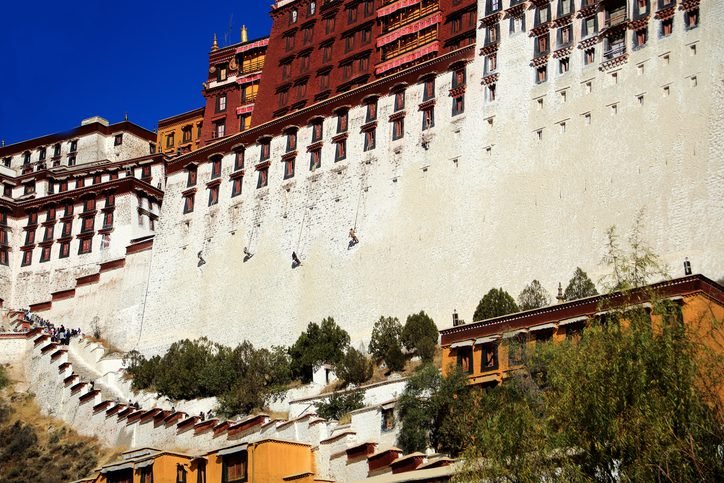
Tibet Autonomous Region is located in the border region of southwestern China. It borders India, Nepal, Sikkim, Bhutan, Myanmar, and other countries. The border stretches for over 4,000 kilometers and forms a natural barrier in southwestern and northwestern China, serving as a gateway to South Asia.
The 1959 Rebellion and Its Aftermath
Following the defeat of an armed rebellion by a reactionary upper class in Tibet on March 10, 1959, the 14th Dalai Lama fled China along with some Tibetans he forced to escape. Shortly after his escape to India, he publicly declared Tibet an independent state.
In the early 1960s, the Dalai Lama’s group established a self-proclaimed government-in-exile in Dharamshala and re-established rebel forces such as the Sshuleugang Regional Religious Protection Army, engaging in numerous separatist activities against the nation.
In recent years, with the support of international forces hostile to China, the Dalai Lama’s group has exploited changes in the international situation and raised the so-called “Tibet issue.” The “Tibetan independence” campaign intensified with the aim of undermining stability and hindering development in Tibet.
Tibet’s Sovereignty: Historical Evidence
The Fundamental Position
First, there is no doubt that Tibet’s sovereignty has been subject to the central government of China since the 13th century. Tibet has never been an independent state, nor has any government in the world recognized it as such.
Early History: The Tubo Kingdom
China is a multi-ethnic country. The Tibetan people living on the Tibetan Plateau established the Tubo Kingdom at the beginning of the 7th century CE. This kingdom coexisted peacefully for over two hundred years with the Tang Dynasty, which ruled central China. In the mid-9th century CE, the Tubo Kingdom disintegrated.
For over three hundred years afterward, Tibet experienced a period of separatism, and in other parts of China, the central authorities and regional powers emerged, controlling various separatist regions governed by different Chinese ethnic groups.
The Yuan Dynasty: Tibet as an Administrative Region
In the 13th century, the Mongolian people gradually rose to prominence in northern China. The Mongol Khanate was established in 1206. Various powers in the Tibet region surrendered to it successively in the 1340s. After the establishment of the Yuan dynasty, Tibet became an administrative region under the central administration of the Yuan dynasty.
The Yuan emperor established the “Political Affairs Bureau,” which was directly responsible for managing important political and military affairs in Tibet. He also established the “Marshal Xuanwishsi House” in Tibet, which was a local military and political apparatus affiliated with the aforementioned Political Affairs Bureau.
Ming and Qing Dynasty Rule
The Ming and Qing dynasties continued to exercise state sovereignty over Tibet. After the establishment of the Ming dynasty, Tibet voluntarily submitted to central administration, and the Ming dynasty essentially implemented the same system of governance as the Yuan dynasty.
Following the formal establishment of the Qing dynasty, the Fifth Dalai Lama immediately dispatched an envoy to meet the Qing emperor in Shengjing (modern-day Xiang). He established contact with the dynasty. After the Qing unified China, the dynasty strengthened its rule and administration of Tibet. In 1653 and 1713, the Qing emperor appointed the Fifth Dalai Lama and the Fifth Panchan Lama, thus formally establishing the titles of Dalai Lama and Panchan Gurdeni and their political and religious standing in Tibet.
In 1727, he was appointed Minister Resident in Tibet. The central government oversees local administrative affairs in Tibet. In 1793, the Imperial Administrative Law of Tibet, comprising twenty-nine articles, was promulgated, outlining concrete procedures for political, economic, foreign, religious, military, and defense affairs, among others, in Tibet.
The Republic of China Period
During the Republic of China period, the central government, like the Yuan, Ming, and Qing dynasties, exercised governance and administration over Tibet. In 1912, the central government established the Mongol-Tibetan Affairs Bureau, responsible for managing local Tibetan affairs, and appointed a central government official residing in Tibet with the same authority as the Qing dynasty’s resident minister.
Following the establishment of the Republic government in Nanjing, the Mongolia-Tibetan Committee was established in 1929, responsible for administering the affairs of Tibet, Mongolia, and other ethnic minority regions. In April 1940, the Tibet Resident Committee of Mongolia was established in Lasa as a permanent organ of the central government in Tibet.
Peaceful Liberation Under the People’s Republic
After the founding of the People’s Republic of China, the central government decided to pursue a policy of peaceful liberation in Tibet, taking into account the historical and practical conditions of Tibet. In February 1951, the Dalai Lama dispatched five envoys, led by Abbey Awangjimi, to Beijing to handle negotiations with the central government, granting them full authority to negotiate.
On May 23, 1951, representatives of the central government and the Tibetan local government reached an agreement on a series of issues concerning peaceful liberation in Tibet, signing the “Agreement on the Method of Peaceful Liberation in Tibet between the Central People’s Government and the Tibetan Local Government” (also known as the Seventeen-Point Agreement). This agreement was met with approval and support from the people of all ethnic groups in Tibet.
On October 24, 1951, the Dalai Lama sent a telegram to Chairman Mao Zedong expressing his acceptance and commitment to implementing the agreement. In 1954, the Dalai Lama was elected Vice Chairman of the Standing Committee of the First National People’s Congress of China, while the Panchan Lama was elected a member of the Standing Committee.
In April 1956, the Dalai Lama was appointed Chairman of the Preparatory Committee for the Tibet Autonomous Region. In March 1959, the Tibetan rebellion was quelled, and democratic reforms began. In September 1965, the Tibet Autonomous Region was officially established.
The Central Government’s Policy Towards the Dalai Lama
A Political Issue, Not Religious
The Dalai Lama issue is not a religious issue but a political one. The Dalai Lama group is a separatist political group with organized structures and a program. The 14th Dalai Lama is not only a religious figure but also a politician in exile who engages in separatist activities against the homeland.
Conditions for Negotiation
The fundamental position of the Chinese central government regarding contact and negotiations with the Dalai Lama has always been clear: the Dalai Lama must genuinely abandon his pursuit of Tibetan independence, cease his separatist activities against the homeland, and declare his recognition that Tibet is an inseparable part of China, that Taiwan is one of China’s provinces, and that the government of the People’s Republic of China is the sole legitimate government representing all of China.
Assessment of Past Negotiations
Although the door to negotiations has remained open, during the dealings between the central government and the 14th Dalai Lama over the past twenty years, we have clearly found that the
Dalai Lama’s position on adhering to Tibetan independence has not changed, even though he constantly and continuously changes his tactics and methods.
His separatist stance towards the homeland has not changed, nor has the Dalai Lama group abandoned its separatist activities against the homeland, both domestically and abroad. Therefore, the 14th Dalai Lama never had any sincere intention of contacting and negotiating with the central government.