Adolf Hitler: Biography, Rise to Power, World War II and Death
April 20, 1889 – April 30, 1945 – German
Adolf Hitler was a German politician and leader of the Nazi Party (National Socialist German Workers’ Party) and one of the most infamous and powerful dictators of the 20th century. He led Germany during World War II. Hitler is considered the mastermind of the Holocaust. His best-known book is Mein Kampf.
Biography of Adolf Hitler
Adolf Hitler was born on April 20, 1889, in the small town of Branau am Inn on the German-Austrian border. He was the fourth of six children born to Alois Hitler and his third wife, Clara Pölzel. During his childhood, the family moved several times, including to the city of Passau in Germany. There, young Adolf learned German with a Bavarian accent, an accent that would remain evident in his speeches for the rest of his life. After his father retired from the customs office, the family moved to Haffeld, where they engaged in beekeeping and farming.
Adolf Hitler had a very tense relationship with his father. His adolescence was marked by constant rebellion against the strictness of his parents and his father. Finally, his father forced him to go to the Linz Technical School in 1900. Not wanting to follow his father’s path as a civil servant, he began to rebel in high school and eventually dropped out after failing his studies. His father died in 1903, freeing young Adolf to pursue his dream of becoming an artist. However, he was rejected after two attempts at the Vienna Academy of Fine Arts.
After his mother’s death in 1908, Adolf Hitler moved to Vienna, where he lived in boarding houses and homeless shelters because he had no money. He worked as a laborer and sold his paintings of Viennese landscapes to earn a living. It was during his years in Vienna that he became interested in politics. The atmosphere in which he lived and the sources he read shaped and developed many of his Nazi and anti-Semitic ideas.
Adolf Hitler’s presence in World War I
In 1913, Adolf Hitler moved to Munich, and the following year, with the outbreak of World War I, he joined the Bavarian Infantry Regiment. In October 1914, he was sent to Belgium. He served in the war, receiving the Iron Cross, 1st and 2nd Class, and the Black Wound Badge. Hitler was wounded twice during the war: once in the leg and once in the eye.
It was in Berlin that news of the armistice and Germany’s defeat in World War I broke. Adolf Hitler, like many other Germans, believed that the country’s devastating defeat was not the result of the Allies but rather the fault of traitors within the country. He believed that Germany had been stabbed in the back by civilians such as Jews, Marxists, and the November Criminals – the signatories of the Armistice.
Adolf Hitler’s entry into politics
After returning to Munich in 1918, Adolf Hitler remained in the army due to his lack of education and career prospects, and soon joined the German Workers’ Party to influence the party. The party’s goal was to unite the interests of the working class with strong German nationalism. Hitler’s charismatic personality and skillful oratory skills led him to rise through the ranks of the party, and in 1920, after leaving the army, he became the party’s propaganda officer.
The German Workers’ Party changed its name to the National Socialist German Workers’ Party, or Nazi Party, and Adolf Hitler personally designed its symbol: the ancient swastika in a white circle on a red background. A symbol that would take on terrifying power in the years that followed.
On the evening of November 8, 1923, members of the National Socialist German Workers’ Party militia forced their way into a beer hall where another right-wing leader was giving a speech to a crowd of 3,000. Adolf Hitler, brandishing a revolver, declared the beginning of a national revolution and clashed with the police.
Adolf Hitler quickly fled to the home of Ernst Hanfstengel, where he reportedly contemplated suicide. He and the other rebels were arrested and tried. Although the putsch failed miserably, it made Hitler a national figure and established him as a hero of right-wing nationalism in the eyes of many Germans.
Adolf Hitler as a writer
Adolf Hitler was tried for treason and sentenced to five years in prison, but spent only nine months, and then in relative comfort, in Landsberg Castle. It was during this time that he wrote Mein Kampf , originally titled Four and a Half Years of Struggle Against Lies, Stupidity and Cowardice . The first volume was published in 1925. Hitler completed the second volume after his release while resting in the mountain region of Berchtesgaden. Initially a mediocre seller, the book became the second best-selling book in Germany after the Bible with Hitler’s resurgence in power, selling about 6 million copies by 1940.
Adolf Hitler’s second book, ” The Second Book, ” dealt with his views on foreign policy. The first English translation of the book was published in 1962 as ” Hitler’s Secret Book .”
Shortly before Adolf Hitler’s parole, the Bavarian government attempted to return him to Austria, but his Austrian citizenship had been invalidated due to his service in the German army, and Adolf Hitler officially renounced his Austrian citizenship on April 7, 1925.
After his release from prison, Hitler’s opportunity for political agitation was limited, as Germany had emerged from war and the economy was recovering. Hitler was forced to respect the authority of the state and seek political power only through democratic means.
Reorganization of the Nazi Party
However, the Bavarian authorities banned Adolf Hitler from public speaking after his provocative speech on 27 February 1925, a ban that lasted until 1927. Despite this ban, Hitler, in pursuit of his political ambitions, employed Otto Strasser, Joseph Goebbels, and Gregor Strasser to organize and expand the Nazi Party in northern Germany. Gregor Strasser took a more independent political path, emphasizing the socialist elements of the party’s program.
On October 24, 1929, the US stock market crashed. This event had a devastating effect on the German economy: some of the largest banks collapsed and millions of Germans were unemployed. The Nazi Party seized the opportunity to consolidate its position. They promised to reject the Treaty of Versailles and create jobs while strengthening the economy.
The September 1930 elections led to the collapse of a grand coalition and its replacement by a minority cabinet. Rule by decree became the new norm, paving the way for the establishment of an authoritarian government. The Nazi Party became the second largest party in parliament in the 1930 elections, winning 18.3% of the vote and 107 seats.
Although Adolf Hitler had renounced his Austrian citizenship in 1925, he was not able to obtain German citizenship until almost seven years later. In other words, he was stateless and legally unable to run for public office, and he was also at risk of deportation. On February 25, 1932, a member of the Nazi Party, Dietrich Klags, who was the Minister of the Interior of the state of Brunswick, appointed Hitler as the head of the state delegation to the Reichsrat in Berlin, thus making Hitler a citizen of Brunswick and therefore German.
Adolf Hitler’s rise to power
Adolf Hitler ran for his party in the 1932 election and, although he lost to Hindenburg, became a powerful figure in German politics. Shortly afterwards, Hindenburg reluctantly appointed Hitler as chancellor. As chancellor, Hitler used all his strength to form a government to defeat the opposition parties. Finally, on March 23, 1933, with the passage of the Enabling Act, Hitler’s government became a legal dictatorship. Other political parties and trade unions were quickly dissolved and their leaders arrested. On July 14, 1933, the Nazi Party was declared the only legal political party in Germany.
In 1933, Germany was diplomatically isolated, with a weak military and hostile neighbors. In a May speech, Adolf Hitler claimed in a conciliatory tone that Germany sought peace and disarmament. However, his main goal behind this strategy of appeasement was domination and the spread of the idea of the people. Early the following year, Hitler withdrew Germany from the League of Nations and began to strengthen the country’s military in order to advance his future plans.
With the death of Hindenburg on 2 August 1934, the military leaders agreed to combine the presidency and chancellorship, and Adolf Hitler was officially named Führer and soon assumed personal command of the Reich’s armed forces. By February 1938, all generals accused of not collaborating with the Nazi Party had been purged. Hitler believed in racial purity, or the idea of ethnic purity, and intended to place the Aryan race at the top. In his view, the truest embodiment of the unity of the German people lay not in a democratic, parliamentary government but in a supreme leader, or Führer.
Enacting anti-Semitic laws
On September 15, 1935, the Nuremberg Laws were passed, stripping Jews of German citizenship and prohibiting them from marrying or having family ties with Germans. Over the next few years, Jews were denied the right to vote and were stripped of their civil and political rights. In addition to widespread anti-Semitism, Adolf Hitler’s government sought to establish Nazi cultural dominance by burning books, desegregating newspapers, using radio and film for propaganda purposes, and forcing teachers throughout the German education system to join the party. Much of the persecution of Jews and opponents of the system was carried out by the secret police and the SS.
The beginning of World War II
In March 1933, Adolf Hitler ordered the occupation of the demilitarized left bank of the Rhine. Over the next two years, Germany allied with Italy and Japan, annexed Austria, and revolted against Czechoslovakia. All of this without resistance from Great Britain, France, or other members of the League of Nations. In May 1939, Hitler reaffirmed his alliance with Italy and then signed a non-aggression pact with the Soviet Union. On September 1, 1939, Nazi forces invaded Poland, and Britain and France eventually declared war on Germany.
Beginning in 1933, the SS had established a network of concentration camps, such as Dachau, to hold Jews and other opponents of the Nazi regime. After the war began, the Nazis switched from expelling Jews to exterminating them. Mobile death squads executed entire Jewish communities during the Soviet invasion, and the network of existing concentration camps led to death camps such as Auschwitz .
With the German defeat at Stalingrad and the landing of American forces in North Africa, the tide turned against the Germans. In this situation, Adolf Hitler became increasingly isolated and dependent on medication prescribed by his personal physician. Several attempts were planned on his life, including a bombing in July 1944 during a conference at Hitler’s headquarters in East Prussia. After January 1945, he hid in a bunker under the Chancellery building in Berlin. At midnight on 28–29 April, he married Eva Braun in the Berlin bunker and, after dictating his political will, shot himself on 30 April. Eva Braun also took her own life with poison. Their bodies were cremated on Hitler’s orders.
Adolf Hitler’s books
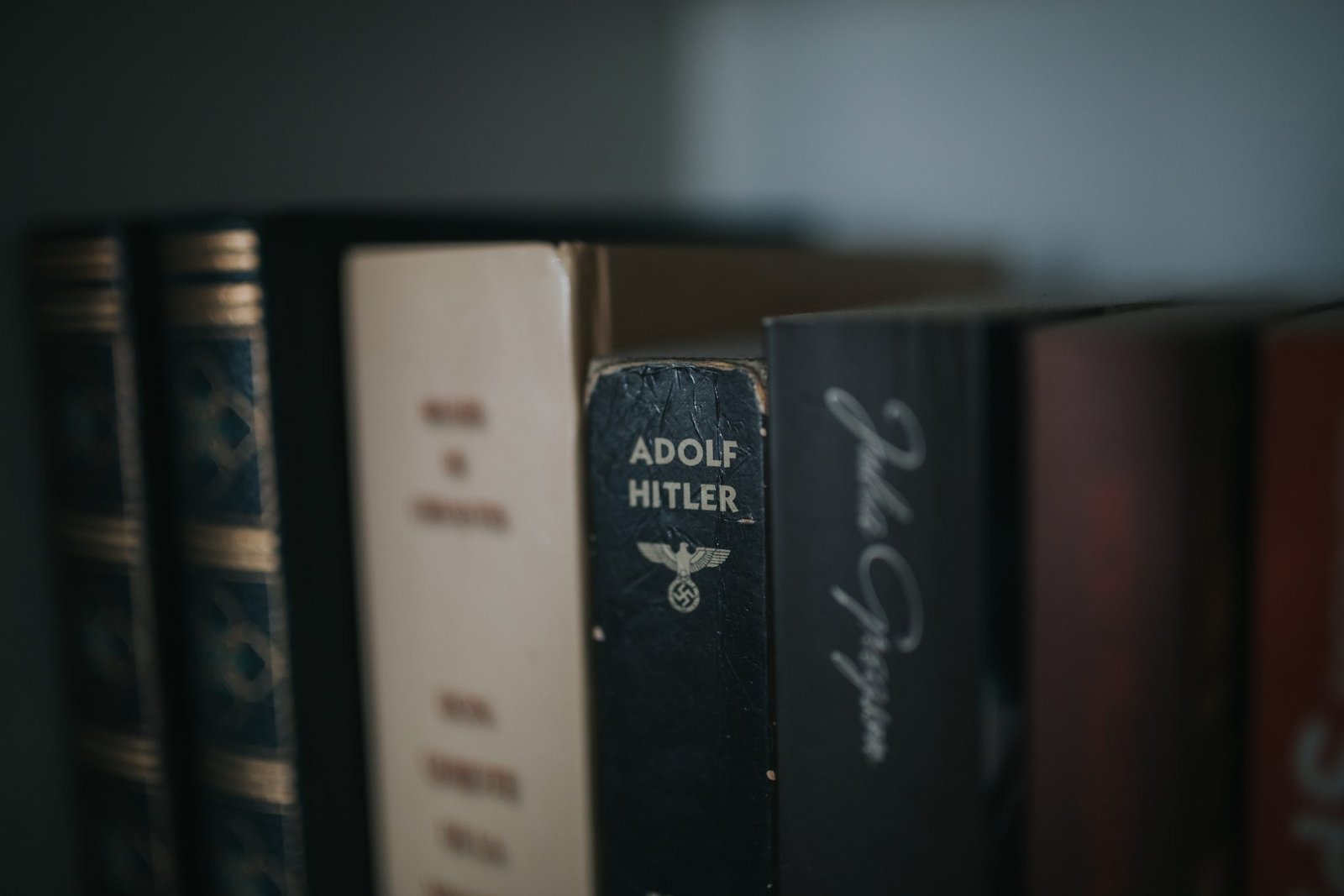
Mein Kampf: Written in the form of an autobiography , this book is an exposition of Adolf Hitler’s ideology. In it, Hitler outlines his plans to transform German society into one based on a master race. After Hitler’s death, the copyright of the book was transferred to the Bavarian state government, which refused to allow any copies or printing of the book in Germany until 2016, when the copyright expired.
The electronic book “Nabrad Man” translated by Fereshteh Akbarpour and the audio book “Nabrad Man” translated by Yasman Bahreini are available on the Ketabrah website and app.
Interesting facts about Adolf Hitler
- Hitler suffered from hysterical blindness and lost his sight twice.
- While Hitler supported classical Greek and Roman artwork, he was highly critical of contemporary movements such as Impressionism, Cubism, and Dada.
- Adolf Hitler was a vegetarian and a non-smoker, but he used narcotics such as oxycodone, methamphetamine, morphine, and even cocaine.
- Adolf Hitler was a billionaire. He used his vast fortune, estimated by some to be around $5 billion, to amass an extensive art collection, purchase furniture, and acquire real estate.
- In 1939, a Swedish legislator nominated Hitler for the Nobel Peace Prize. In 1935, the German journalist Karl von Ossitzky, a staunch critic of Hitler, had been nominated for the Peace Prize. This gesture was seen as an insult to Germany and an insult to Nazism. As a result, Hitler banned all Germans from accepting the Nobel Prize and replaced it with the German National Prize for Arts and Sciences. Three Germans who subsequently won Nobel Prizes during the Third Reich were forced to decline their awards.
- In 2009, researchers determined that a skull fragment with a bullet wound and thought to be Hitler’s remains actually belonged to a woman.
Selected quotes from Adolf Hitler
- Reading is not an end in itself, but a means to an end. (My Battle Book)
- The art of reading and studying is to remember the essentials and forget the non-essentials. (My Battle Book)
- Learning history means searching for and finding the forces that led to the effects that we perceive as historical events. (My Battle Book)
- He who wants to survive must fight. He who does not want to fight in this world where constant struggle is the law of life, has no right. (The Book of My Battle)
- The conqueror will never be asked whether he told the truth. (Hitler’s letters and notes)