
Introduction to Egyptian Architecture
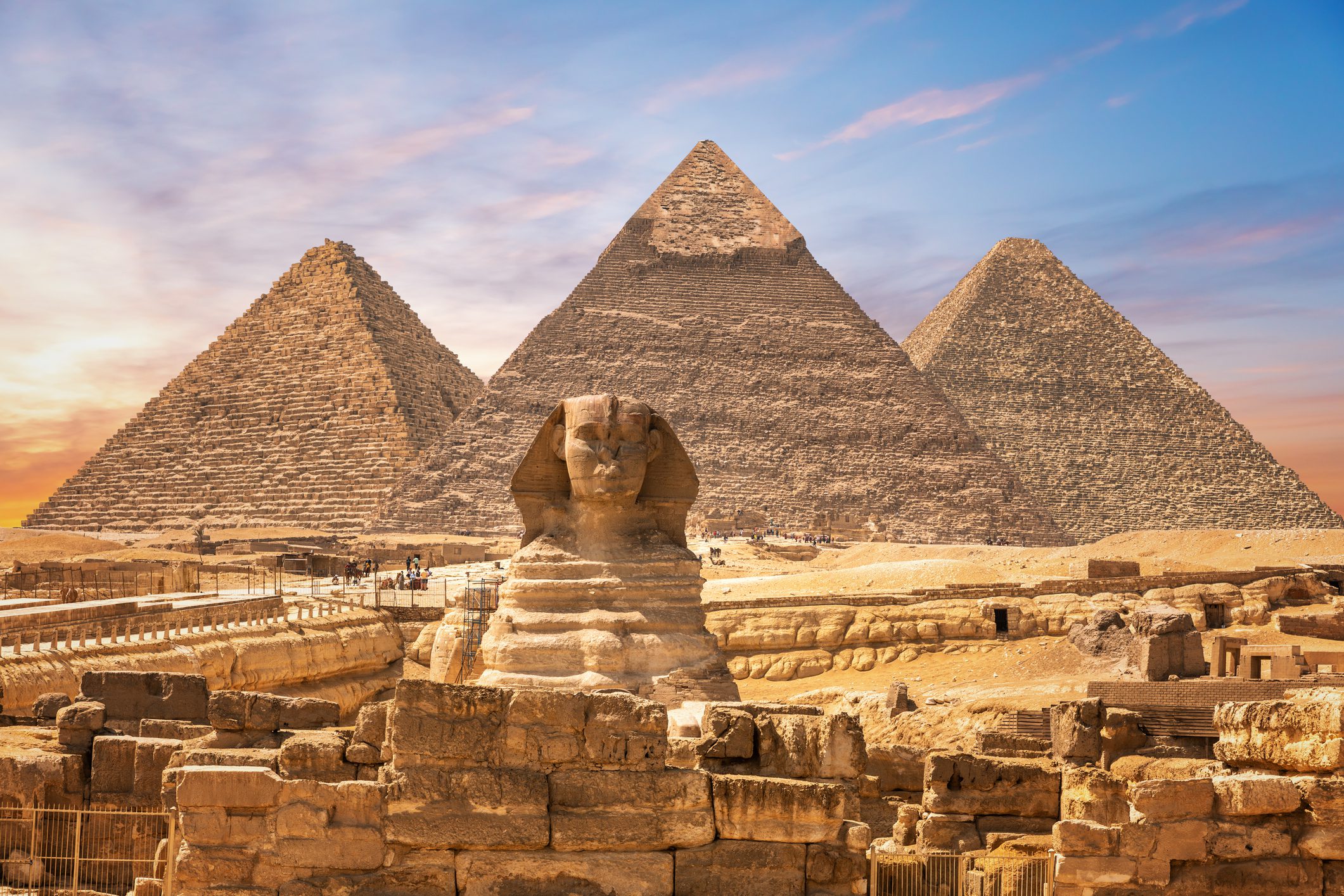
Egyptian architecture has been a story of the secrets and genius of the architects of this ancient land throughout history, which has led to the creation of unique masterpieces. For about 10,000 years, the Nile Valley was the site of one of the most influential and magnificent civilizations of its time. Even today, some of the remains of this ancient civilization, such as the pyramids and the Sphinx, are considered among the most famous and amazing historical monuments in the world. Egypt is a treasure trove of architectural works that is unparalleled in its kind.
Materials and Construction Methods
Two Categories of Architectural Works
The architectural works left by the ancient Egyptian civilization are generally divided into two categories according to the materials used in their construction. The first category is buildings in which the materials used were unbaked bricks. This type of brick was used in the construction of Egyptian houses during the Pharaonic, Greek, Coptic and Islamic civilizations and is used in the construction of rural houses today.
The second type is stone architecture. Egypt had a rich reserve of stone mines such as basalt, lime, marble and granite. The exploitation of stone mines was carried out under the supervision of the government. On the one hand, this was due to the importance of construction projects at that time, and on the other hand, the workers had to live in the vicinity of the stone quarry from which the building in question was to be formed until the work was completed, so the protection of the valuable materials of these buildings was considered important.
Tools and Architectural Planning
One of the interesting points worth noting in the construction of the amazing buildings of Egypt is the simplicity of the tools of the workers of that era in comparison to the creation of these amazing buildings. In fact, this issue has been more than ever an expression of the genius and creativity of the architects of that era. During the time of the Pharaohs, the existence of an architectural plan was considered essential before starting to build a building.
Examples of these plans can be seen on jars and stones. In fact, in ancient Egypt, craftsmen who had special skills in building and presenting its design passed on their experiences from generation to generation in the form of an expert and left behind the masterpieces that we witness today.
Historical Periods of Ancient Egypt
The Ancient Egyptian period has 3 periods:
- Ancient Egypt
- Middle Egypt
- New Egypt
The Egyptians were an eternalist people. In Egypt, any architecture related to the next world is made of stone, and any architecture related to this era is made of brick and mortal. Therefore, they built a solid stone tomb for the dead and mummified the dead. The Egyptian temples were all made of stone and they worshipped the sun god. The Egyptian obelisk (monument to the sun god) is a symbol of the Egyptian god and is known as the obelisk.

Egyptian Temples
Types of Temples
Temples in Egypt are of two types: 1- Temples for worshipping the gods, such as the Temple of Horus in Edfu 2- Temples of the Dead, such as the Temple of Queen Hatshepsut at Deir el-Bahri and the giant rock temple of Ramses II at Abu-Simbel.
The columns in these temples have no structural aspect at all and are only facades. In the modern period of Egypt, new temples and tombs were built, such as the Temple of Amen, the Temple of Karnak, the Tomb of Queen Hatshepsut, and the Temple of Horus.
Temple Architecture and Components
Egyptian temples, especially the Temple of Amen and Horus, have two important parts: an entrance called a pylon, in front of which are two statues of Ramses, and then other statues of Ramses, arranged in a row (peristyle). After that is a courtyard with columns, and the main part of the temple is a covered area with columns.
Characteristics of Egyptian Architecture
One of the characteristics of the Egyptians was their high religiosity. They built their houses from less durable materials and built the tombs and tombs of the kings from durable materials such as stone. Egyptian architecture is a geometric architecture, meaning that volume and form were so important that architectural space was not considered.
Architectural Periods
—Old Kingdom architecture —Middle Kingdom architecture —New Kingdom architecture
Old Kingdom Architecture
Old Kingdom architecture: 3000 BC. During this period, mastaba tomb architecture emerged. The Step Pyramid of Djoser dates back to 2750 BC. Its difference from ziggurats is its type of use. The first tombs built in Egypt were called mastabas, which were individual tombs made of stone and were about 2.5 meters high from the ground. The first tomb built for a pharaoh was a five-story mud-brick ziggurat for the pharaoh named Zuser at Saqqara, built by the architect Imhotep.
Royal Tombs and Religious Architecture
The construction of royal tombs was very important in ancient times. In fact, attention to the construction of these tombs dates back to the early days of ancient Egyptian civilization. In addition to these tombs, which were the pinnacle of architectural art, the construction of shrines was also of great value. The government dedicated its best materials, architects, and artists to the construction of these buildings.
Various Architectural Styles
Military Architecture
Apart from architecture that served religion and funeral ceremonies, another type of architecture called military architecture was also prevalent in Egypt, which was represented by the castles and towers that were built at that time. This type of architecture reached its peak during the rule of the Ayyubid dynasty (the Islamic dynasty in Egypt founded by Saladin the Ayyubid), and prominent examples of this architectural style are Saladin Castle and Al-Muzaffar Fortress.
Urban Architecture
Another style of architecture that developed greatly during the Greek era was urban architecture. An example of this architecture is the Lighthouse of Alexander, which is considered one of the third wonders of the ancient world. The construction of this lighthouse began during the reign of Ptolemy I and was completed during the reign of Ptolemy II. The Lighthouse of Alexander is 150 meters long and worked as a guide for ships day and night until the 19th century.
Islamic Architecture
Another type of architecture that included the construction of any type of building flourished during the Islamic era. The construction of mosques, schools, palaces, castles and houses are manifestations of this type of architecture.

The Egyptian Pyramids
The ancient Egyptians built the pyramids of Egypt when the pharaoh and his queen died. The pharaohs were buried underground in various ways and forms, and this tradition continued until the beginning of the Old Kingdom of ancient Egypt, and ended during the reign of the pharaohs in the Middle Kingdom and a new method was invented. To date, about eighty (80) of the pyramids of ancient Egypt are known, three of which are the largest and best of them.
All three of which are related to the Old Kingdom. The largest pyramid built in Giza or Giza was built during the reign of Pharaoh Khufu. The oldest pyramid of Egypt was built by the genius architect Imhotep for Pharaoh Djoser. Next to these amazing pyramids is a large statue called the Great Sphinx, which was the guardian of the Egyptian pyramids. Other very surprising points have been learned from the Egyptian pyramids, which we must owe to the experiments carried out.
Thousands of years have passed since the first great pyramid of the pharaohs, which was built by order of Djoser, the second king of the Third Dynasty of the pharaohs. The foundation of these pyramids, which are considered one of the greatest seven wonders of the world, is still considered a masterpiece of engineering, design, and architecture today.
The First Pyramid: Djoser’s Step Pyramid
Around 2,630 BC, Pharaoh Djoser decided to build the first great pyramid as his tomb. The architect and mastermind behind the design of this great tomb was a famous monk and sculptor named Imhotep. The location of this tomb was determined 10 miles from Phoenix in the Saqqara neighborhood and 61 meters above the quicksand of the desert along the Nile River. Surveying, construction of water channels, and transportation of limestone and granite stones 900 kilometers from the mines began.
At that time, most of the country’s population, which reached 1.2 million people, was mobilized to build this tomb. After confirming and determining the geographical coordinates of this place and performing religious-traditional ceremonies of sacrifice, excavation work began. This was the first and largest building that mankind had ever built. The pyramid was built in six steps. The Egyptians believed that the soul of the pharaoh ascended to heaven and joined God through these steps.
A main entrance and 13 virtual entrances were built to allow visitors to return to the site. At this time, a special written language was developed for recording matters, records, administrative matters, maps, numbering and specifying the location of stones, and the like, which was not used for writing history and ordinary social matters.
Construction Methods and Workforce
Building Teams and Tools
The builder, surveyor, stonemason, carpenter, mortar maker, and foreman were among the people who participated in the construction of this building. After numbering, the cut stones were transported to the pyramid construction site by sleds that moved on parallel timbers, similar to railroad ties. They used water, soft soil, and oil to lubricate the sleds on the ties. In recent excavations of these works, about 600 other tombs of workers near the Pyramid of Khufu were discovered.
A study of the skeletons of these people showed many lesions in their spines, amputations of fingers and toes, and more severe deformities caused by carrying heavy stones. Most measuring tools at that time were made of copper or stone and had wooden handles. Measuring tools also included levels, plumb lines, and the like.
Construction Process
To raise the stones onto the pyramid, embankments with a suitable slope were used. After the work was completed and the last stone was placed on the roof of the pyramid, religious ceremonies and animal sacrifices were performed, and the mounds on top of the pyramid were removed up to 9 meters. With the scaffolding in place, the work of finishing, leveling, and polishing the outer surface of the pyramid was carried out by stonemasons.
This operation continued until the bottom of the pyramid. The pyramid was connected to the Nile River by a covered walkway. This walkway was intended to have several different parts, including a coastal temple, a covered walkway, a burial place for the ships carrying the pharaoh’s body, a temple of the dead, side pyramids, and a shrine to bring the pharaoh to the main tomb.
Detailed Pyramid Construction Process
Mining and Stone Extraction
At first glance, you will notice that these tunnels were excavated, just like all the mines we see today. Let us go to the site of a tunnel a few miles from the pyramids. This place may have once been the largest stone mine in the world. The entrance to the cave clearly shows that this vast tunnel was dug by human hands. The irregular carvings on the granite surfaces indicate that primitive tools such as axes and hatchets once tore open the heart of these mines.
Here are blocks of stone scattered around. Stones with uneven and irregular edges. The whole mine bears clear signs of a systematic process designed to cut and transport these pieces of stone out of the mine.
Tools and Their Limitations
It is likely that the stone-cutting tools such as axes and hatchets were made of copper, the hardest metal known at the time (iron was discovered many years after ancient Egypt). But Tools made of copper were not capable of being used more than one hundred to one hundred and fifty times, and after this time they became dull and useless. Therefore, there had to be a staff to resharpen these tools, and many blacksmiths spent days sharpening and polishing the tools of their work. Using these same tools, miners carved large stone blocks weighing 2.5 to 50 tons of granite. These were actually considered the bricks for building the pyramids.
The Philosophy Behind the Egyptian Pyramids
The Egyptian pyramids were built in 2500 BC by the second pharaoh of the Fourth Dynasty, King Khufu. According to Egyptian legends, he was commissioned to build a structure that would save the royal family and, more importantly, the Egyptian culture and civilization from destruction. He was right to succeed in this mission. In fact, the pyramids were tombs for the kings of Egypt, but not an ordinary cemetery.
The idea is that Egyptian astronomers had observed a point in the sky for years around which the stars revolved during the night (in fact, the northern celestial pole, a place that is today identified near the North Star), and they believed that this place was the eternal home of the gods. The location and alignment of the pyramids were created so that they were located just below this point, and the shape of the pyramids from above represents the rays of sunlight.
In fact, these pyramids were built to bring the gods to the eternal point with the rays that they sent towards the eternal point. They would realize their direction and the land of Egypt would be noticed by the gods. It was also the place for the king’s soul to ascend to the eternal point so that he could live there eternally. For this reason, sacred objects such as gold, a staff, and a sacred threshing floor were buried with the king so that the king could continue his rule on the other side of the galaxy with these objects and be the guardian of Egyptian culture.
The Three Pyramids of Giza
During the reign of the pharaohs, another pyramid was built. One of the Seven Wonders of the World is the Triple Pyramids of Giza, named after Khufu, Khafr, and Menkaure, located a few kilometers south of Cairo. The Triple Pyramids of Egypt are a masterpiece of engineering, design, and architecture. The cutting and measuring of the stones was astonishingly precise, so that the slightest error would have caused the geometric shapes to collapse and even the building to collapse. These buildings are the largest buildings ever built by man.
The Pyramid of Khufu: The Great Pyramid
The largest pyramid, named after Khufu, was built with dimensions of 230 meters on a side and 146.59 meters high. About 2.3 million stones were used in the construction of this pyramid, each weighing an average of 2.5 tons. In total, about 5.8 million tons of stone were used in this building. The Greek historian Herodotus estimated the construction time of the road and waterway to start this building as 10 years, the construction time of the pyramid as 20 years, and the number of its workers as 100,000 people.
Its entrance from the north is 18 meters above ground level, and its corridor continues with a slope to 20 meters below the base of the pyramid. From there, it is connected to the queen’s chamber by another corridor. However, the queen was not buried there after her death. Another corridor, 8.5 meters high and 46.5 meters long, ends at the site of the pharaoh’s tomb, which has dimensions of 21.5 by 10.43 and a height of 82.5 meters. The pharaoh’s tomb is located at a height of 42.28 meters from the base of the pyramid. After the pharaoh was buried, all the entrances to it were blocked by huge stones, and there was no possibility of entering it.
The Second Pyramid: Khafre
The second pyramid, called “Khepri”, was built with dimensions of 215.25 and a height of 143.5 meters, and the third pyramid of the Triple Pyramids was built with a height of 5.66 meters, about halfway between the other two pyramids. Near the Nile River, the Sphinx was built to guard the tomb, half a lion and the other half the pharaoh himself. This statue was half-finished at the time of the pharaoh’s death, and like other unfinished works that remain unfinished when another pharaoh comes, its construction was never completed.
Historical Details of Khufu
Khufu (Cheops) was the second king of the Fourth Dynasty of Egypt, who ruled for nearly a quarter of a century from about 2551 BC. He founded the Giza complex, forty kilometers north of Dahshur, near modern Cairo and the ancient city of Memphis. The complex has five main elements: the pyramids of Khufu, Khafre, and Nekure, the Great Sphinx, and the Valley Temple of the Pyramid of Khafre. Of the three pyramids of Giza, the Pyramid of Khufu is the oldest and largest, dating back to about 2570 BC. This enormous stone monument was known as the “pyramid of the rising and setting of the sun.”

The Pyramid of Khafre in Detail
Khafre was the fourth king of the Fourth Dynasty and the son (or brother?) of Khufu. He built the second Great Pyramid of Giza and the Great Sphinx, both of which were built around 2530 BC. Khafre ruled Egypt for 26 years, from around 2558 BC.
Architectural Specifications
The Pyramid of Khafre, located southwest of the Great Pyramid of Khufu, is 136.5 meters high (while its original height was 143.5 meters), the length of each base is 215.8 meters, and the angle of inclination of the pyramid is 53 degrees and 20 minutes. In images, the Pyramid of Khafre appears taller than the Great Pyramid of Khufu because it is located on a higher surface. During the Old Kingdom, it was part of the religious regulations to have the entrances on the northern side of the pyramids, facing the North Star. This was observed in all the pyramids; the only exception is the Pyramid of Khafre, which has two entrances on the northern side.
Limestone Covering
After the base of the pyramids was built, their bodies were covered with white, shiny limestone; the covering was done from the top of the pyramid downwards. In this way, pieces of limestone were placed on the steps and filled in the gaps, then they were carved and smoothed downwards to find the right angle and give them a shiny appearance. All the pyramids, except the Step Pyramids of Djoser, Midum and Menkaure, had a covering. Part of the limestone covering of the top of the Pyramid of Khafre still exists, but the covering stones of the Pyramid of Khufu were quarried in the Middle Ages for use in the construction of buildings in Cairo.
The Pyramid of Menkaure
Menkaure was the fifth king of the Fourth Dynasty and the son of Khafre, who ruled Egypt for twenty-nine years from about 2532 BC. He built the smallest pyramid on the Giza Plateau, which is the third of the three pyramids. This pyramid was 5.66 meters high, which has been reduced to 62 meters today. The pyramid has an inclination angle of 51 degrees and 20 minutes and the length of its base is 5.108 meters. It is located in the southwest of the two neighboring great pyramids. The aforementioned pyramid was also built around 2510 BC.
Unique Two-Tone Construction
The Pyramid of Menkaure has two-tone stones: its upper half is covered with white limestone, while its lower part is made of reddish granite from the Aswan region. This pyramid is very noteworthy because it is the only pyramid of the Fourth Dynasty of Egypt to have 16 rows of granite stonework. It was planned that the surface of this pyramid would be covered with granite stones, but due to the sudden death of Menkaure, this was never realized and the pyramid remained without a covering.

The Great Sphinx
Another notable element in the Giza complex is the colossal and astonishing Sphinx (Statue of Death). Located 400 meters from the Triple Pyramids and north of the Valley Temple of Khafre, this statue is also known as the Guardian of the Pyramids.
Description and Significance
The Sphinx is the oldest and largest statue in the ancient world, and despite the extensive damage it suffered during the Arab conquest, which caused the loss of part of its face, it is considered the most magnificent royal symbol of the pharaohs. The Sphinx faces east, and a small temple has been built between its claws. The stones used in the temple are mostly cut from the natural rock that forms the Sphinx, and some of them weigh more than 200 tons.
Valley Temple of the Pyramid of Khafre
This temple is located 400 meters east of the pyramid complex and was built entirely of cleanly cut and polished red sandstone using the square-sectioned beam and column method. The only decoration used in this temple was the statues that were arranged in rows along the wall. The floor of the temple was also covered with white marble.
Architectural Innovation: The Skylight
Because the ancient Egyptians did not use cement to erect columns, they considered their dimensions and proportions large. When creating columned halls, in most cases, the middle row of columns was considered taller than the side columns in order to install a row of skylights to bring sunlight into the building in that section. Such a construction method was initially observed in the Valley Temple of the Pyramid of Khafre. It seems that this row of skylights was an Egyptian invention, an innovation that is used to this day as one of the important elements of architecture.
Scientific Discoveries About the Pyramids
Results of Experiments Conducted
Perishable foods remain inside the pyramid for a long time without spoiling. Contaminated water is purified and free of germs. Plants grow faster. Rusted metals regain their original shine and polish Humans achieve better rest and human thinking power is also increased. Relaxation and treatment of mental illnesses are done with greater ease.
The Discovery of Pyramid Properties
The problem that led to the discovery of these properties in pyramid-shaped objects for the first time was the observation that the dead animals inside the main tomb of the Pharaoh in the Great Pyramid, although they had lost their water, did not rot. As a result of this observation, mankind realized that perhaps the special shape of the pyramid was involved in this phenomenon. To investigate this issue, they built a pyramid 75 centimeters high and placed the body of a cat directly under the top of the pyramid and at a distance of one third of the height of the pyramid from its base.
They observed that the cat had become a mummy a short time later without any decomposition or decay. Finally, the results of this experiment were published, and it was announced that there are certain proportions between the shape of the pyramid and the physical, chemical and biological effects of the space inside it, and by observing these proportions, the effects of the Nasheed can be intensified.
Modern Scientific Understanding
Contrary to the popular belief that for 500 years the Pyramid of Giza was merely a great tomb for Cheops and that the order to build it was the sole cause of his egotistical complexes, scientists have now discovered that this amazing structure was a treasure trove of engineering, mathematics, geodesy, astronomy, architecture, and other known sciences of our own time.


1 thought on “From Djoser to Giza: Egypt’s Architectural Wonders”
Great to know about them even more!!!