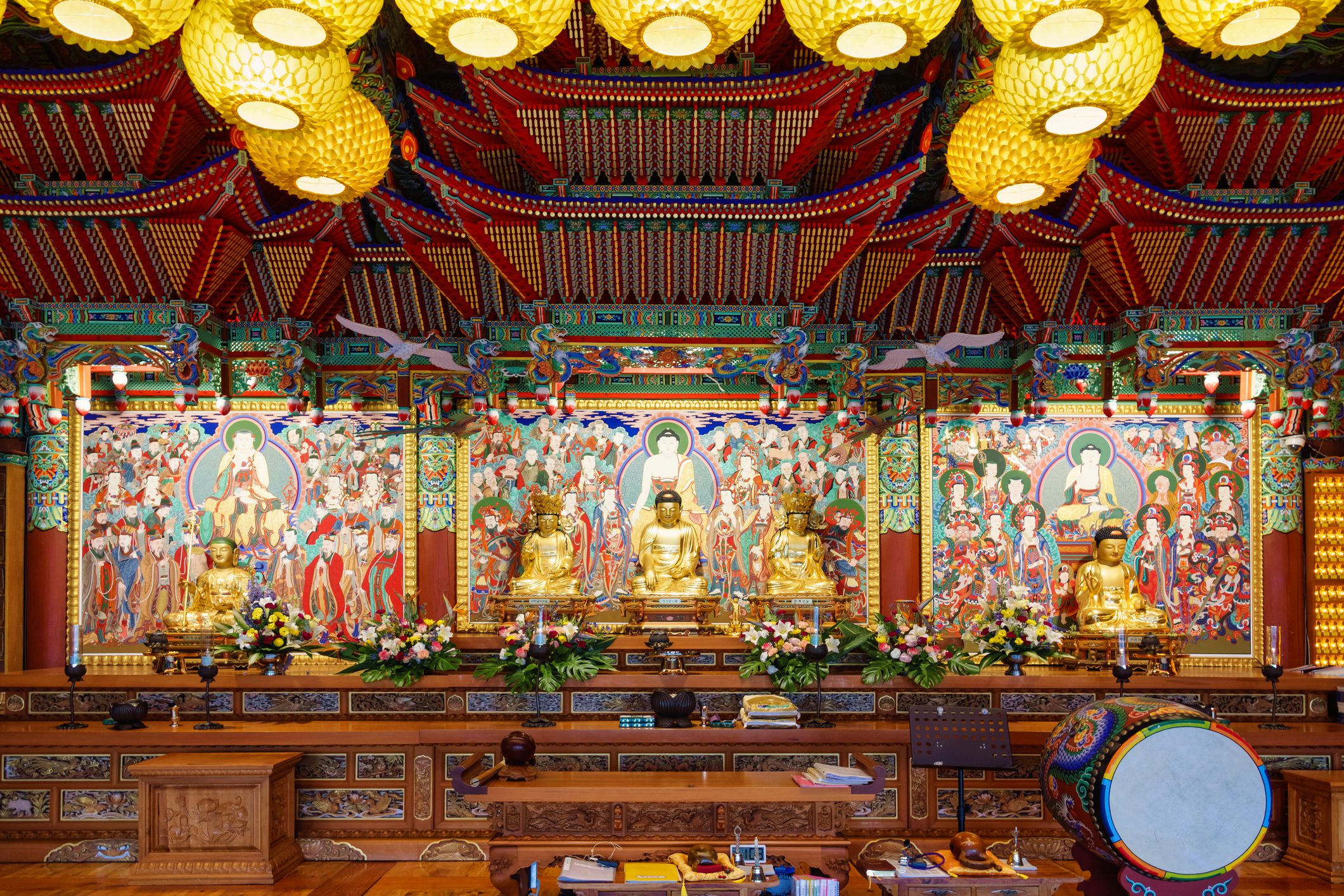
The Beginning of Buddhism in China
Buddhism was first introduced to China by trade, about the beginning of the first century AD. It is generally believed that the first penetration of this new religion into the earlier ancient civilizations of the East was by merchants from Central Asia, a region which had been strongly influenced by Buddhism since the time of Ashoka. It seems reasonable, however, that a significant stream of Buddhist culture may have also reached Southeast Asia by sea, and from there to southern China at about the same date. In any case, Buddhism did not initially have a significant impact on the Chinese.
Early Resistance and Acceptance
The Chinese were quite content with their own indigenous systems of thought, such as Taoism (1) and Confucianism (2), and were even somewhat disgusted by the Buddha’s emphasis on renunciation and celibacy. These were concepts that were at odds with the ideals of Chinese ideals established in that society. All this changed when China’s stable political and social system began to disintegrate in the second century AD.
In 148 AD, a Buddhist missionary named An Shih-kao (3) succeeded in translating Buddhist scriptures into Chinese for the first time. These translations were not of high quality, as they required the invention of Buddhist terms in Chinese, and at first, they used Taoist terms to express Buddhist ideas. This led to a conflation of Taoist and Buddhist ideas in the minds of the Chinese. During the early days of Buddhism in China, at first, short instructional pamphlets and manuals on meditation were translated rather than lengthy philosophical treatises.

Political Upheaval and Buddhist Growth
With the collapse of the Han Dynasty (4) in 220 AD, China entered a period of political discord and social disorder that lasted until the rise of the Sui Dynasty (5) in 589 AD. Despite the fact that the Chinese imperial dynasties were still trying to maintain a foothold in northern China, their fortunes began to decline. In 311 CE, barbarian tribes from the Central Asian steppes invaded China, disrupting Chinese political dominance in northern China for almost 300 years.
This political upheaval caused a migration of educated and official monks from the north to the south, eventually settling in an area called Qin-Kong (6), near the modern city of Nanjing (7). Here they collaborated in the formation of the Eastern Qin dynasty (8) and played a major role in the intellectual life of the region. From the amalgamation of these intellectuals and religious leaders, for the first time a Buddhism associated with the upper classes, or “aristocratic” Buddhism, emerged.
Two Levels of Chinese Buddhism
The Buddhist nobility emphasized both Buddhism and Chinese scholarship, and went to extremes in philosophical debates, and literary activities were based on a fusion of Taoist and Buddhist ideas. In the north, Buddhism also flourished in the new states founded by barbarian tribes. But Buddhism developed at different levels in these states; in the north, Buddhism was a state religion created for the purposes and protection of the foreign rulers of the region. Monks in northern China often played both a political and a religious role in the government, and were skilled in political and military matters.
The peasants in northern China had a very different view of the benefits of Buddhism. They were attracted to Buddhism because becoming a monk meant exemption from taxes and forced labor. In addition, Buddhism in northern China evolved in a ritualistic way that allowed the peasantry to participate in such rituals as making offerings to temples, going on pilgrimages, and praying to various bodhisattvas. From the very beginning, two separate and often distinct levels of Chinese Buddhism emerged.
On the one hand, there was a philosophical and contemplative Buddhism, reserved for the upper classes, which allowed for leisurely and unhurried religious ceremonies, and on the other hand, a more ritualistic Buddhism, with its emphasis on supernatural assistance and intercession, which was typical of the peasantry.
The Golden Age of Chinese Buddhism
With the rise of the Tang Dynasty (9) in the early 600s, Buddhism in China entered its golden age. The early rulers of this period were very supportive of the religion, and sent Buddhist monks to India to obtain and translate the new sacred texts. Thus, in the history of Chinese Buddhism, such notable figures as Hsuan-tsang (10) (c. 596-664 AD), who traveled overland to India, and I-tsing (11) who left Canton (12) in a Persian merchant ship in 671 AD, brought new life to Chinese Buddhism.
Major Philosophical Schools
This translation fever was accompanied, in turn, by exciting new philosophical developments. Many of these new philosophical developments were uniquely Chinese in their orientation. The four major schools of new Buddhist philosophy were Tien-tai (13), Hua-yin (14), Chen (15) (Zen), and Pure Land Buddhism [= Buddhist Paradise]. Although all these schools agreed with the fundamental principles of Buddhism as expressed by the Buddha, their interpretation of these principles was informed by Mahayana views and indigenous Chinese philosophy.
The T’ien-t’ai School
The T’ien-t’ai school seems to have been founded about 550 CE. It takes its name from the mountain monastery built by Hui-su (16) (515-567 CE). The school, whose main teaching text was the Lotus Sutra (17), expressed a similar tendency towards meditation and theoretical analysis. T’ien-t’ai developed an incredibly complex philosophical system intended to integrate all the philosophical schools of Buddhism into a harmonious whole. From this system also emerged a precise system of meditation.
The Hua-yin School
The Hwa-yin or Flower-Ring School (flourishing period, ca. 650-750 CE) was primarily concerned with philosophical analysis. This school, first with the concept of pre-titiya-samut pada, believed that all phenomena are necessary and interpenetrating. From this concept, the Hava-yin thinkers developed a very complex metaphysical system that greatly influenced the philosophical development of the schools that emerged after it.
Chen (Zen) Buddhism
Chen (Zen) Buddhism emerged in a somewhat different direction from the complex philosophical schools we have just discussed. It believed that the core of Buddhism lay not in philosophy or doctrinal texts but in the direct experience of ultimate reality. This could be achieved through a rigorous program of meditation. Rather than relying on communally owned plots of land, as was the case in older, more established monastic systems, Chen monks wandered from place to place, relying on public charity and personal labor to earn a living.
Pure Land Buddhism
Also significant was the emergence of Pure Land Buddhism (18). This school or schools, all based to some extent on the Buddhist scriptures known as the Pure Land Sutras, believed that human efforts to achieve salvation were insufficient given the deteriorating nature of the existing world. It is therefore necessary to seek the supernatural help of the Bodhisattvas and Buddhas who live in other worlds – the “Pure Lands”. These Pure Lands, like our own, have not declined due to the death of this Buddha-world.
These Buddhas, and especially the Buddha Amida (19), were regarded as beings who, if the aspirants uttered their names with full faith, would cause their rebirth in the Pure Lands, where the attainment of Nirvana was certain. Since this form of Buddhism did not require long and tedious periods of meditation, but rather involved the performance of individual acts of piety, it was more suited to the difficult physical life of a peasant than the philosophical and ascetic Buddhism of the upper classes.

Buddhism’s Spread to Japan and Korea
Chinese Buddhism, at the height of its fame and prestige, was in the most favorable position for its spread. The Tang dynasty of China was the undisputed center of world civilization, and it attracted other East Asian countries like a magnet. Consequently, ships carrying Japanese political agents and ambassadors from various Korean provinces were constantly heading for the capital of the Chinese Empire, Cheng-an. From there, these ships, laden with not only examples of Chinese art and technology, but also with new, and in some cases revolutionary, religious ideas, set out for their homelands.
Early Penetration into Korea and Japan
It is not true to say that Buddhism did not penetrate Korean and Japanese cultures until the eighth century. Authentic records show that it had penetrated the Korean peninsula in various forms by the second or third century. In fact, it was from there that it reached Japan in the early years of the fifth century. But these new forms of Buddhist tradition, which had evolved in China during the Tang Dynasty, had to be further refined in Korea and Japan, and made compatible with the identities of both countries.
Buddhism in Korea
Korea and Japan were undergoing major political transformations at this time. They were moving from local autonomy to more centralized forms of government. In Korea, the three dynasties of Koguryo (22), Silla (23), and Paekche (24) were fiercely fighting for control of the peninsula. When Silla finally emerged victorious in 668 CE, the new central government sought to unify the various Buddhist schools under a single state temple.
During this period of reform, Korean Buddhist philosophers presented some of the most radical philosophical ideas the religion had ever explored. Buddhism, strongly supported by the Silla dynasty and its successors in Korea, grew rapidly until the 13th century. Eventually, the Korean form of Zen, Sen (25), increasingly dominated Korean Buddhism. But other philosophies, such as Neo-Confucianism, began to grow in opposition to Buddhism, enjoying state support.
This, combined with successive foreign invasions and natural disasters, contributed to the decline of Buddhism’s prestige and prestige until the present [20th] century.

Buddhism in Japan
Similar developments took place in Japan. Buddhism, which had initially been frowned upon by the Japanese as an unnecessary foreign commodity, quickly became an established institution in Japan. The emperor and his court were initially uninterested in the purifying aspects of Buddhist doctrine, until they came to believe, on a somewhat superstitious note, that Buddhist rituals would protect their country from natural disasters and evil spirits better than their native Shinto gods.
Japanese Buddhist Reformers
This belief persisted until the late eighth century, when two great reformers, Saicho (27) (767-822 CE), who founded the Tendai (28) school (Japanese form of Tin-tai), and Kokai (29) (774-835 CE), founder of the Tantric Shingon (30) school, a school based on religious observance and ritual, returned from China with new views on religion, according to which Buddhism should be understood as a religion and not as magic. Moreover, it was not long before the common people showed interest in the Pure Land Buddhism taught by Honen Shonin (31) (1133–1212) and his disciple Shinran (32) (1173–1262).
Nationalist Buddhism and Military Influence
In the 13th century, further changes occurred in Japanese Buddhism. A reformer named Hichiren (33) (1222–1282) began to promote a highly nationalistic form of Buddhism, believing that Japan had become the true spiritual homeland of religion. Meanwhile, as Japan became increasingly embroiled in civil war, the emerging military classes came to support the austere principles of Zen Buddhism as the most suitable religion for the dangerous and difficult lives they led. Thus, gradually, Buddhism in Japan became associated with patriotism and national pride. This had important effects on that country in the 20th century.
Tibet and the Rise of Vajrayana Buddhism
The rise of Vajrayana Buddhism was closely linked with the rise of the Tibetan state. From a very realistic point of view, it is surprising that anyone could live in Tibet, let alone the successes that the Tibetan people have achieved in this land. This high, rocky, dry and desolate region has few natural resources to attract humans to settle there. Nor does it have an exceptionally strategic geographical location. However, it has long been the home of nomadic herding tribes.
The First Introduction of Buddhism to Tibet
Around 600 AD, a dynasty arose in central Tibet around the city of Lhasa (34) that was able to bring the Tibetan plateau under its rule. The first and greatest of these kings was Sangtsen Gampo (35) (609-649 AD). To consolidate his power and improve his foreign relations, the king married two wives, one from Nepal to the south and the other from the Chinese Empire to the north. Both wives were Buddhists, and this undoubtedly contributed to the spread of Buddhism.
But more important than all this was the fact that as Tibet became more unified, the kings of Lhasa found that the ancient Bon-Po religion (36) was not able to satisfy their political ambitions as well as Buddhism could. Moreover, Tibet was looking beyond its borders for the first time. During the reign of Sangtsen Gampo, envoys were sent to India who modified the common Sanskrit script for use in writing the Tibetan language. (It is noteworthy that the Sanskrit script is Avangar, and Tibetan, like Chinese, is a syllabary.) There is no doubt that, on the other hand, adventurous Buddhist missionary expeditions came to Tibet from the Himalayan passes, and from the mountains of eastern China.
Padmasambhava and Early Tibetan Buddhism
The earliest date of their arrival is lost in the dust of time, but the legendary accounts attribute the establishment of Buddhism in Tibet to an exceptional holy man, Padmasambhava (37), who apparently came to Tibet in the seventh century. Padmasambhava, as these legendary accounts suggest, was a great figure of astonishing magical power, acquired by strenuous austerities, secret rites, and long periods of meditation. He, who is credited with subduing the dangerous and fierce gods of the mountains, is also said to have been the founder of the Jokhang (38), the first Buddhist temple, in Lhasa during the reign of Sangtsen Gampo.
The Shantrakshita Mission and the Great Debate
The arrival of Buddhism in Tibet is most clearly seen in the reports of the Shantrakshita Mission. Shantrakshita, an Indian tantric master, who was invited to Tibet by the second great religious king, Trisang Detsen (c. 704-797), founded Samye (41), another early great Buddhist temple in Tibet. It was at this time, between 792 and 794, that the course of Tibetan Buddhism was forever determined.
These years are known as the period of the great debate between Kamalasi (42), the Indian tantric representative of Buddhism, and the Zen Buddhist monk Hu-shang of the Mahayana school from mainland China. After these debates, Tibetan Buddhism was modeled on Indian Buddhism, especially on its tantric form. It is also from this period that the Tibetans made considerable efforts to obtain Buddhist texts from India and translate them into their own language. The Tibetans were very successful in this, for many texts now lost in their homeland are still available in Tibetan translations.
The Dark Period and Second Introduction
But the spread of Buddhism in Tibet was not without its difficulties. The last of the great religious kings, Ral Pachen (43) (805-838 CE), was a weak ruler and was killed by his brother Langdarma (44). The new king did not like Buddhism and tried to suppress it in Tibet. Despite the fact that he died in 842 after a brief reign of only four years. Murdered by a Buddhist monk, his reign marked the end of both the first introduction of Buddhism to Tibet and its reign as a secular kingdom. It was at this time that a dark period began for Tibet for 150 years.
This period ended around 1000 CE. It was from this time that the second introduction of Buddhism to Tibet began, not in central Tibet, but in the western part of the country. At this time, the Buddhist teacher Atisha (45) (c. 982–1054 CE) brought new teachings from a university in Vikramashila (46) in India to this part of the country, before traveling to central Tibet.
As in eastern Tibet, Tibetans such as Drugma (47) and Marpa (48) (c. 1012–1096 CE) undertook arduous journeys to the Indian plains in search of spiritual teachers from whom they could learn the latest trends in Buddhism. With the influx of new ideas came a renewed interest in Buddhist ritual, and most of the Buddhist schools began to be founded from this date.
Major Tibetan Buddhist Schools
The Nyingmapa School
The oldest of these schools was the Nyingmapa (49) or “Old Ones” school, which believed that its origins predated the second founding of Buddhism in the early 11th century CE. Unlike other schools of Tibetan Buddhism, the Nyingmapa allowed their monks to marry and start families. The Nyingmapai, in the freest possible way, were essentially individualistic in character, emphasizing local subjects such as divination, agricultural ceremonies, and exorcism.
The Sakya School
Another of the oldest Tibetan schools is the Sakya school (50), founded by Konchog Gyalpo (51) (1034–1102 CE). It was known for its main monastery at Sakya, in south-central Tibet, especially for its educational system, known as the Lamdra system (52) (which skillfully combined tantric instruction with formal Buddhist texts), and for its emphasis on a particular text, the Hwajera Tantra (53).
The school quickly influenced religious and secular events, and when one of its leading monks became the official teacher of the Sino-Mongol emperor Kublai Khan, the emperor entrusted him with the secular affairs of the entire country and later with the administration of a province of the Mongol Empire. Thus began the long tradition of governing Tibet according to Buddhist monastic rules. This continued until 1951.
The Kagyu School
The lineage of the Kagyu school (54) goes back to Marpa and his famous disciple Milarepa (55) (1052-1135). Both teachers are known for their magical skills, and Milarepa is also considered to be the most prominent poet of Tibet. The Kagyu was the first school to introduce the concept of the Tulku (56). A Tulku is a highly advanced monk, usually the founder of a particular order, who is repeatedly reincarnated and takes up residence in a new body to resume his duties in the order of which he is the leader.
Later, the Kagyu system was the first to be recognized for its potential expansion in Europe and America, and a number of famous contemporary monks such as Chogyam Trungpa (57) and Choje Ekong (58) are affiliated with this system.
The Gelugpa School
But among the Tibetan schools, the most famous is the school of the Dalai Lama, the Gelugpa or Yellow Hat school. Founded by Tsongkhapa (59) (1357-1419) as a reform movement at the beginning of the 15th century, the Gelugpa school soon became the pre-eminent school of Buddhism in Tibet, and one of Tsongkhapa’s disciples, Gendun-Drup (60) (1391-1474), was the first head of the school known as the Dalai Lama.
His successors were regarded, at the same time, as reincarnations of him and of Avalokiteshvara, the Bodhisattva of Compassion. In 1642, the Fifth Dalai Lama became the ruler of all Tibet, and this position continued until the Chinese government deposed the current 15th Dalai Lama in 1959. He was exiled from Tibet.